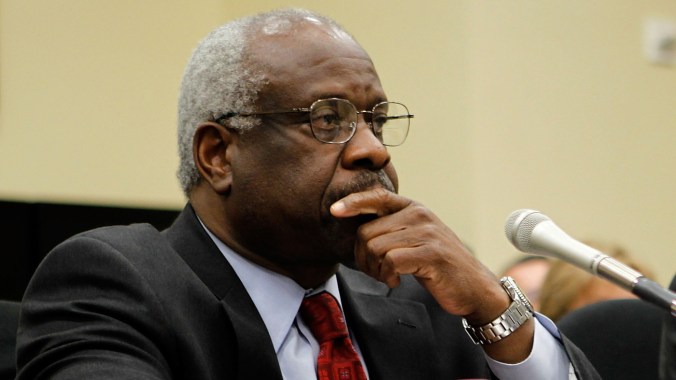
Clarence Thomas- An American Icon

U.S. Supreme Court Justice Clarence Thomas recently spoke at the Federalist Society Florida Lawyer’s Chapter Conference. His remarks were inspiring as all in attendance were treated to a fascinating dialogue between the justice and his former clerk, D.C. Circuit Judge Greg Katsas. Justice Thomas shared his life story and his journey to the Supreme Court. He also provided some insight into his judicial philosophy.  The following day, there was a screening of his new documentary, “Created Equal” that further elaborated on his life story and was designed as a series of interviews with Justice Thomas. This piece will focus on some highlights and what makes Justice Thomas an American icon that should be revered in society today.

Justice Thomas begins by discussing his early life that was spent with his mother and brother growing up in the poverty of the deep south- him and his brother would often roam the streets while his mother was at work and rarely attended school. Eventually, his mother realized she was not in a strong enough position to provide for their needs and sent him and his brother off to live and be raised by his Grandfather and Grandmother. This was the first turning point in Justice Thomas’ life. His Grandfather instilled in him a sense of moral discipline, Catholic faith and hard work. In addition to attending school, the young Justice Thomas was expected to pitch in on the family farm and assist his Grandfather with oil deliveries. His Grandfather exerted “tough love” and this would enhance Justice Thomas’ early development.

Later Justice Thomas entered into the seminary and after initial reluctance, his Grandfather supported him and said if he is was going to invest himself into it, he was to complete it (a lesson he would later use during his Supreme Court hearings).  While attending the seminary, however, he experienced some bouts with racism and began to question his purpose there. This was his second major turning point. After Martin Luther King Jr. was assassinated a fellow seminarian was heard lauding it and this was the last straw for Thomas. Shortly, thereafter, in the midst of the racial tension occurring in society, most notably in the deep south, he left the seminary. This act deeply strained his relationship with his Grandfather who had always encouraged Thomas to persevere and not make excuses despite the acts of others. Thomas then went to live with his mother and then later enrolled in the College of the Holy Cross for college. There he joined some special interest organizations focused on radical activism in what he described as the “Black Power Movement” and entered a rebel phase. He described being a participant in charged protests in the nearby community concerning race relations.

Although he spent considerable time with the activism, he was a good student and following graduation was admitted into Yale Law School. There he did well in school, but again was reminded of the state of race relations. He questioned his place there and whether it was more out of special treatment or for his intellectual prowess. On interviews following graduation, he found it difficult to land a job despite interviewing in several cities in what he described as country club style hiring practices. An African-American from Yale would never be viewed in the same light as a Caucasian because of the preferences questions.

He eventually found a position with Missouri Attorney General Jack Danforth in St. Louis. Justice Thomas spoke fondly of his time there and of Danforth serving as a mentor to him early in his career. This was a third major turning point in his life. Danforth would eventually be elected to the United States Senate and following his election, Thomas would work for a time at Monsanto Chemical Corporation.

Later, Justice Thomas eventually followed now-Senator Danforth to D.C. as a legislative assistant for a few years. After working up the D.C. ranks and establishing a solid network he was eventually named chairman of the Equal Employment Opportunity Commission by President Reagan. Following his time serving in the Reagan Administration, George H.W. Bush became President and promptly named Thomas to serve as a circuit judge on the D.C. Circuit, a court widely seen as having the most influence below the Supreme Court.

Justice Thomas sat on the D.C. Circuit for a short time before Justice Thurgood Marshall announced his retirement from the Supreme Court. President Bush then had a difficult decision to make on who he would nominate to replace Marshall. Justice Thomas openly admitted when asked about being appointed as a judge, “its not something I was even looking for or wanted, but it is something God wanted, so I was obliged to follow his will.” This was another turning point in Justice Thomas’ life.  President Bush decided to nominate Justice Thomas and the confirmation hearings went relatively smooth except with regards to clear partisan and awkwardly phrased questions from the senate panel in regards to the abortion issue- a common thread from the Bork hearings to Kavanaugh hearings in the present day. Justice Thomas described the experience as “you are sitting in front of questioners who have no idea what they heck they are talking about” in reference to the political hits disguised as “legal theory”. One exchange fondly recounted and shown on footage is Joe Biden trying to engage in a deep philosophical natural law question, but awkwardly phrased to try and pry an answer on abortion from Justice Thomas.

On the eve of the final vote, however, the hearings took an extreme turn.  Anita Hill, a former staffer for Justice Thomas and presently a law professor made sexual harassment allegations against him. These resulted in separate hearings before the final vote with the attention of the entire nation.

Shortly before the news broke, Justice Thomas had thought it strange that the FBI had set up a follow up background call with him to ask questions. When the news eventually broke, he was befuddled about the allegations and understood them as to having no basis. He had to ask his wife, who watched the testimony provided by Hill (he did not watch) because he could not recollect any issues he had. He noted that Anita Hill had commonly solicited his help for professional opportunities stemming from her time in service under him and event went so far as to drive him to the airport following some of his presentations. In terms of the testimony itself, when Anita Hill is speaking as provided in the documentary- after the questions were asked – she commonly had looked down and had to wait a second as if to recollect a memorized statement in response to the questioning. It gave the impression that she was trained to speak certain words. In a notable exchange with a senator who pointed out some contradictions in her story such as why she sought his help and kept in contact with him despite the “allegations” for several years she responded, “you know that is a really good question, I do not even know.” There were many signs of dishonesty, but the media persisted with the narrative.

The ensuing brawl of the news media put enormous pressure on his family. Similar to the Kavanaugh hearings in the present day, his family relied on private prayer and bible study with the support of friends. The Thomas family kept their faith through the trying times and it brought them through the experience.

At one point, the hearings and confirmation were looking dim with the fueling of the mass media and a Democrat-controlled senate chamber and Thomas knew that he had to rise to the challenge. Footage in the documentary highlighted his discussion with Senator Danforth shortly before his own testimony before the final vote. As they discussed his emotions, Justice Thomas openly stated the entire experience felt like a “high-tech lynching” and Danforth encouraged him to present himself and freely speak his emotions so the Americans can see the genuine nature of Justice Thomas, a man so unfairly wronged and the “wrong black guy” per Justice Thomas’ words as a conservative. During his final testimony, he did in fact describe the entire experience as a “high-tech lynching for uppity blacks that dared to think in their own way.” The senators and nation were stunned by those words and statements from the heart. He edged his way to confirmation with a vote of 52-48.

As for Justice Thomas’ tenure on the Supreme Court he has become a pillar of Constitutionalism and one of the greatest judges in the modern age. There are many cases in which Justice Thomas does not shy away from an unpopular outcome or reasoning and gladly distinguishes  himself from fellow judges on the bench when composing his opinions if he finds that is what the Constitution requires. We have discussed some of these opinions in detail in other pieces. He has become a rebel in this sense in a good manner channeling his energy and intellect to upholding fundamental constitutional principles despite being in the face of unfair and misinformed resistance by the media and other members of the legal academy. This mentality should be lauded. He further grasps a major premise that if a case deciding an issue was wrongly decided in the past, there is no obligation to continue to uphold bad law rather the obligation is to correct the error and make it Constitutionally compatible. He does not lose sight of where his power as a jurist flows from, the Constitution itself and reminds us that is the overarching arbiter of decision making, not policy concerns and issues best addressed by the legislature.

Overall, Justice Thomas’ talk at the Florida Federalist Society Lawyer’s Chapter and documentary, “Created Equal” were wonderful experiences and should be shown in schools and definitely can engage the interest of people in legal and in non-legal circles alike. It’s the story of a man who persevered through the obstacles faced in life in many ways, had moments when he veered off and questioned his purpose, but with God’s grace found himself to realign back on the path his Grandfather had set forth for him. His is a true American story, an icon of our time and who we all should be grateful sits on the highest court in the land. It reminds us that in America, even a poor child in the streets can one day become an iconic figure and inspire others.

Justice Kavanaugh on Law and Religion

Brett Kavanaugh is in the early stages of his tenure on the Supreme Court. In the coming years, he will have many opportunities to become an integral part of the evolution of the Supreme Court’s law and religion jurisprudence. Here, we reflect on some law and religion issues he has tackled thus far on the Supreme Court.

American Legion v. American Humanist Association (2019)

In this matter, the American Humanist Association brought suit to challenge the Bladensburg WWI memorial cross on a Maryland highway. It alleged a violation of the Establishment Clause. We have discussed this case in-depth in prior posts. The Fourth Circuit had previously held that the cross did violate the Establishment Clause. The Supreme Court granted certiorari on the matter and decided it in June 2019. It overturned the Fourth Circuit with a 7-2 decision, however, there were various opinions composed by the justices. For purposes of this post, we will focus on Justice Kavanaugh’s opinion.

Justice Kavanaugh’s concurring opinion acknowledged that the court relied on the history and tradition test when assessing the status of the cross and moved away from the Lemon Test with regard to its analysis. When weighing if a violation of the Establishment Clause existed, the Lemon Test considered most notably whether the challenged government action had a primary effect of advancing or endorsing religion. Justice Kavanaugh classified the Lemon Test as presently bad law and highlighted other cases where the court also did not apply it.

He identified 5 categories of Establishment Clause cases: (1) religious symbols on government property and religious speech at government events; (2) religious accommodations and exemptions from generally applicable laws; (3) government benefits and tax exemptions for religious organizations; (4) religious expression in public schools; and (5) regulation of private religious speech in public forums. He noted that the Lemon Test does not adequately support the court’s prior decisions in those areas. The first area applying in the present matter was a religious memorial in the form of a cross. It was not coercing into a faith belief and stands as a symbol and reflection of lost soldiers from WWI. The original erection of the monument sought to emulate the grave-markers of the fallen troops overseas. It is rooted in history and tradition.

As for the other categories, in terms of religious exemptions passed legislatively, by their very “definition” he explained that they endorse or advance religion in some way, thus in contradiction of the Lemon Test. The court has upheld these exemptions in various cases. Next, the court has a history of upholding government benefits and tax exemptions that go towards religious organizations, thus also in effect endorsing or advancing religion. Fourth, in regards to school prayer, the Court did not rely on the endorsement and advancement standard of Lemon to ban it from public schools, but rather focused on the coercion elements towards the students. Finally, in regards to religious speech, the Court has allowed religious speech in public forums on an equal basis as secular speech. There was no violation of the Establishment Clause found and the Lemon Test was not a valid explanation for those decisions.

Overall, Justice Kavanaugh found the Lemon Test to essentially be dead letter law and that it should not be seriously considered when evaluating Establishment Clause cases. This view along with the further emphasis of the Court on the history and tradition assessment will return the understanding of Constitutional law back to the original understanding of the Establishment Clause. This presents a beacon of optimism in the future of law and religion jurisprudence.

Morris County Board of Chosen Freeholders v. Freedom from Religion Foundation (Cert Denied 2019)

This matter considered whether county historical preservation funds could be applied to religious buildings. The New Jersey Supreme Court ordered the funds not to be dispersed to religious buildings. The U.S. Supreme Court ultimately denied certiorari on this matter, however, Justice Kavanaugh issued a strong opinion agreeing with the denial of cert, but leaving the door open to future challenges on this issue. He also expressed concerns about the anti-religious sentiment growing in this area and how this is inconsistent with the meaning of the First and Fourteenth Amendments.

He focused on two reasons, however, on why the Court here made the decision to deny cert at this time. First, he stated that the factual picture needs clarity and second he would like to see a body of law develop in the wake of the Court’s recent Trinity Lutheran decision where the Court had ruled it was valid for the state to provide funds for tire pieces at a religious school’s playground. Prior to the Supreme Court’s decision, the state had forbid funds to religious private schools, but allowed funding to secular private schools.

It seemed reasonable to conclude that more facts are required in regards to the specific nature of the buildings at issue in this matter on whether they are churches or other religious entities that fall into the historical preservation category. This would allow for a more effective adjudication. The second point, however, is harder to contend with on waiting for more case law to develop from Trinity Lutheran. This case posed an opportunity for the Supreme Court to take an affirmative stand on the issue and provide a form of reinforcement for Trinity Lutheran in recognizing the equality of religious rights. Hopefully, the Supreme Court will take cases similar to this in the coming years to firmly construct a modern enduring standard that is consistent with the original meaning.

Despite not supporting the acceptance of cert at this time, Justice Kavanaugh does pose some interesting points in reflecting on the issue going forward. He emphasizes several Supreme Court cases prior to Trinity Lutheran that sharply attack government discrimination against religion. He puts special attention into classifying religious equality as a “bedrock principle”, that must continue to be applied. He seems eager for the Court to take the correct case on the matter and reinforce its position, but just does not find the fertile ground here with a lack of a history in focusing on the issue of historic grant funds.

He closes with the view that if the factual picture does reveal that funds were prohibited to religious organizations just based on their nature, it would “raise serious questions under this Court’s precedents and the Constitution’s fundamental guarantee of equality.” This recognition provides optimism that the Supreme Court will eventually move in the correct direction in this area, however, this does seem like a missed opportunity to resolve the issue with some permanency.

 Murphy v. Collier (2019)

In Murphy v. Collier, Justice Kavanaugh prepared a concurring opinion on a stay in a death penalty case. In this matter, a Buddhist prisoner was on death row and wanted a Buddhist spiritual adviser to accompany him into the execution room as he was about to be executed. Texas officials would not permit this as only Christian or Muslim advisers were available to accompany inmates into the execution room as they were the only religions represented as official prison chaplains. The Buddhist adviser was to remain in the viewing room because he was not an official chaplain. The execution was ultimately stayed. Justice Kavanaugh emphasized in his concurring opinion that this discriminated against religious denominations.  He considered this an equal treatment case and that the state had two options to remedy the situation: “(1) allow all inmates to have a religious adviser of their religion in the execution room; or (2) allow inmates to have a religious adviser, including any state-employed chaplain, only in the viewing room, not the execution room.” Shortly after the stay was granted, Texas amended its policy to not allow any religious advisors in the execution room, only in the viewing room.

Overall, in this matter Justice Kavanaugh took an approach clearly in support of religious freedom with a sensitivity towards discriminatory conduct directed at a specific faith tradition. On its face this displays a welcomed openness for the Court to continue moving in the direction of greater respect for religious traditions and respect for the role of religion in general. It is worthy of careful protections when confronted with potential discrimination. This concept is translatable to various other cases the Supreme Court has encountered and is bound to encounter in future contexts.

It should be noted, however, that in this situation the factual picture may have benefited from more in-depth reflection. There is a distinction in this matter prior to the stay and ensuing Texas policy change that distinguished and defined the extent of the roles of official prison chaplains compared to other faith advisers. The original Texas policy may not have encompassed the Buddhist advisers because they did not register like other faith traditions as chaplains. The Court could have raised more issues as to what part of the process did discriminatory activity take place, could it have taken place earlier in the chaplain admittance process and now this end remedy is being used to correct the wrong that should have been addressed earlier? Maybe a critical thinking question to consider is an assessment of the nature of the program itself and if it was prone to discrimination when admitting chaplains? While Justice Kavanaugh provided a strong assessment, it would have been beneficial had he went a little deeper into the origins rather than focus simply on the end product.

Conclusion

Overall, although early in his tenure, Justice Kavanaugh has clearly shown a strong interest in Constitutionalist jurisprudence that pays special adherence to the principle of religious freedom. He recognizes the importance of religious protections that are supported by Constitutional law. While we may prefer that the Court move at a faster pace on the issue, the Court will get more opportunities in the coming terms to continue to focus the law in the proper direction and correct the errors of prior Supreme Court rulings in the mid to late twentieth century.

Attorney General Barr’s Defense of Religious Freedom

U.S. Attorney General Bill Barr has made headlines in recent months. Most notably he gave a talk at Notre Dame Law School regarding religious freedom. This drew sharp criticism from the media and several mainstream figures. Attorney General Barr is an inspiring modern-day Constitutionalist and should be lauded for the great work and courage he has showed during his tenure as Attorney General.

Religious Freedom

Attorney General Barr gave an inspiring talk at Notre Dame that focused on the troubling decay of the American society as it moves away from the Judeo-Christian principles upon which it was founded upon. Several of these points were emphasized in his published St. John’s Law Review (formerly The Catholic Lawyer) piece from 1995 titled, “Legal Issues in a New Political Order”.[1]

He noted in the Founding Era that the framers clearly established an intent for religion to act as an effective moral force within the citizens of the nation to maintain a free and just government. It created a sense of moral virtue and self-discipline. Barr discussed John Adams’ view that Constitution was made for people of this inclination and how they would serve as the bedrock of a successful society. Their behavior would contribute to the common good unlike an excessive and unrestrained individual appetite that could draw conflict with other aspects of society. When individuals exercise good moral virtue, they are exercising power separate from their own wills that too often could lead to poor decisions and rather maintain a focus on a transcendent moral authority that will hold them accountable.

Barr than progressed into a discussion on the importance of natural law considerations and how God’s eternal law flows to the natural law which in turn provides a just society with an outline for moral guidance. It provides a sense of conscience considerations and the ability to weigh right and wrong. It forms a healthy moral compass for the citizens of a just society. With the rise of the secular movement and moral relativism in society, this compass is distorted within the citizenry when the concept of faith is relentlessly attacked.  He discussed the detrimental consequences this has on society and cited examples such as family wreckage and instability, dispirited young people, more depression, rising number of suicides, increased drug use and the acceptance of abortion as a remedy for sexual decision making. It is not a coincidence these rises have occurred as religions has been further driven from the public square. The tools to achieve this end commonly arise in pop culture, the entertainment industry and academia. These entities strongly articulate their position, but resist any form of opposition and challenge. In many cases, stifling dissent or ridiculing it to such a degree with mischaracterizations to drive the contrasting viewpoints further from the mainstream.

He concluded with acknowledging the major impact of law on this discourse and current examples where religion was or is currently in the crosshairs. The goal is to destroy traditional values and he rightfully noted the major battlegrounds are in the realm of education and public schools. The courts and legislatures have become vehicles to shape this decay with blatantly unconstitutional decisions or unjust laws passed aimed at targeting religion and its influence in society.

He cited a few recent examples where religion has clearly come under assault. First, curriculum standards that some states have implemented include controversial and contentious social issues without any provisions for parental opt out. This is interfering with the parental right in educating their children. For example, he cited New Jersey, California and Illinois laws that have adopted an LGBT curriculum without an opt out provision for parents concerned about how the issues are presented on such a controversial topic.

Next, he focused on general religious expression and most recently a Montana case where a tax program existed where citizens would receive a credit for donating to a scholarship program for low-income students to attend private schools, but not religious schools. Montana heavily relied on its own Blaine Amendment which is modeled after a failed proposed U.S. Constitutional Amendment that would have banned state funding to religious institutions. Barr explained that the Department of Justice recently filed an amicus brief with the Supreme Court on this case and argued the Montana law is unconstitutional.

Finally, he challenged laws that would force religious schools to adhere to secular orthodoxy such as allowing lawsuits against Catholic schools who did not want to employ individuals that were in a same-sex marriage. This lifestyle example undermines a material Catholic position and teaching on the definition of marriage. Barr explained that lawsuits of this nature infringe on the Diocese’s expression association rights and attack the autonomy of churches. The Department of Justice filed a statement of interest in an Indiana case related to these lawsuits.

Patricia Hackett’s Challenge

Attorney General Barr’s remarks, however, did not go unchallenged. An adjunct law professor from Notre Dame and Democrat Congressional candidate, Patricia Hackett[2], disagreed with the Attorney General’s perspective on religious freedom and history. It was, however, more of a political commentary and less routed in substantive discourse.

Ms. Hackett accused Attorney General Barr of “empowering certain religious institutions over the religious freedom and conscience of all Americans, whether religious or non-religious.” Ms. Hackett fails to realize that the Free Exercise Clause and Establishment Clause provide protections for freedom of religion in a just society, not freedom from religion. The common atheist entities that look to the Establishment Clause for “protection” in several cases do not have a firm Constitutional basis in line with the original intent to bring these actions. As discussed in prior posts, the mid-twentieth – to late twentieth century Supreme Court radically departed from the original intent and correct interpretation of the Establishment Clause. The core meaning of the Establishment Clause is to protect against having a state-run religion that is hostile and intolerant to other faiths and dominates society in a theocratic matter from its position of power. This is what had occurred in England with the Church of England and its oppression on various other sects of faith. The key is compulsion into a single state -run religion, not eradicating any hint of religious representation from government entities or tradition for example a Nativity Cresh on town property or a Menorah during the holiday season. There are also other examples with public schools having major religious holiday vacation days for students or having a non-denominational prayer to open a municipality meeting.

Ms. Hackett’s commentary alleging the first three presidents were deists, rather than organized Christians also is very controversial and not entirely supported by historical record. Take for example, George Washington, who historians have recognized as being active in the Anglican Church in addition to attending services of other denominations. He recognized the importance of established religion and the rights of congregants to practice their faith.[3]  If we, however, do concede Ms. Hackett’s point it still does not change that the intent of the framers was to incorporate protection for religious beliefs and institutions within the Constitution. As evidenced in its place in the First Amendment, this was clearly an issue that was prioritized.

The right to not worship is not provided in the Constitution rather it is a conscience choice that an individual makes to be removed from the religious realm, however, when understanding the context of Establishment Clause this does not mean that one must be compelled into practicing religion or else be punished. This would not be protected under the Constitution. In addition, the Constitution does not specify what religions are protected, just religion in of itself. Outside of the “Judeo-Christian Orthodoxy” there are several other forms of religion that would be entitled to the same rights such as Islam and Hinduism. It is not unreasonable to consider that Attorney General Barr would likely also commandeer the Department of Justice to look into a matter involving a Muslim baker that is facing destruction of his or her business on account of their closely held religious beliefs. Ms. Hackett’s unsubstantiated and broad-based attacks on the Attorney General highlight a lack of a firm understanding of law and religion constitutional interpretation.

Her commentary further soils with political undertones when she accuses him of “dismissing certain outcomes of the rule of law, such as for example, marriage equality, which is the result of reason, evidence and science applied within the courts throughout this nation.” This is a very controversial issue and Ms. Hackett does not show much humbleness or respect for opposing views on the issue such as its constitutionality as a matter of U.S. Constitutional law. Several states had differing views on this issue and 5 Supreme Court justices took one side of the debate. This is far from a unanimous standard and insults those who used reason to reach an opposing outcome. She also fails to elaborate on her evidence and scientific standard that she claims supports her view.

Overall, there were many weaknesses in Ms. Hackett’s rebuttal commentary of Attorney General Barr. As Americans, however, we should appreciate the work of Attorney General Barr as he continues to inspire us with his defense of law and religion issues that are being drawn into the forefront of society and will continue for years to come.

[1] William P. Barr (1995) “Legal Issues in a New Political Order,” The Catholic Lawyer: Vol. 36: No. 1. Article 2.

[2] https://www.ncronline.org/news/people/notre-dame-adjunct-rebuts-barrs-contentious-talk-religious-freedom

[3] mountvernon.org/library/digitalhistory/digital-encyclopedia/article/george-washington-and-religion/

Modern Commentary on the Second Amendment and Gun Law

Today, the Second Amendment has become a focus of controversy in society with the wake of recent school shootings and shootings in public areas. The immediate reaction of major media outlets and political figures is to promote gun control and blame the NRA for these horrific crimes. There are even calls to abolish the Second Amendment. The purpose, however, of the following is to inform on recent developments in Second Amendment jurisprudence and local gun regulations. We will also assess the problematic reactions of society and offer some solutions as to how the troubling rash of gun violence can be addressed. There are other outlets of society that may provide us with answers and ultimately help with correcting the problem.

A. The Text of the Second Amendment and Landmark SCOTUS Cases

The text of the Second Amendment reads, “A well-regulated Militia, being necessary to the security of a free State, the right of the people to keep and bear Arms, shall not be infringed.” In District of Columbia v. Heller (2008), the United States Supreme Court held that the Second Amendment protects an individual right to possess a firearm unconnected with service in a militia, and to use that arm for traditionally lawful purposes, such as self-defense within the home. This decision is discussed in-depth here.

B. Recent Local Issues

Locally, in New Jersey and New York the issue of overly burdensome gun regulations has begun to enter focus.

New Jersey

In New Jersey, a new policy enacted by executive order 83, signed by Governor Phil Murphy states:

  • The Division of Purchase and Property is to issue a request, within 30 days, to all retail dealers or manufacturers of firearms that currently sell ammunition and/or firearms to the State to ascertain whether vendor practices, where applicable, adhere to the applicable public safety principles related to firearms listed in the order.
  • Upon receipt of information from such retailers and manufacturers, the Division of Purchase and Property shall determine whether and how to ensure that any prospective bid solicitation for ammunition and firearms include a requirement that each vendor, prior to award, certify adherence to public safety principles relating to firearms as defined in this order.
  • The Treasurer is instructed to issue a request, within 30 days, to financial institutions providing services to the Department of Treasury, or any of its divisions, offices or agencies, to disclose whether such institutions have adopted any code of conduct or principles related to gun safety or responsible sales of firearms.
  • The Commissioner of Banking and Insurance, within 30 days, is instructed to take all appropriate action within her authority to prohibit and/or limit the sale, procurement, marketing, or distribution of insurance products that may serve to encourage the improper use of firearms.

On its face, the highlights of this order seem to apply undue pressure on retailers of fire arms that sell to the state and financial institutions to demand compliance with the state government’s view of appropriate public safety principles or else face harsh punishment. The Division of Purchase and Property acts as an agency and will enforce the regulations. The agency will be the arbiter on if the retailers are following the appropriate guidelines. The financial institutions will also be forced to disclose to the state treasurer on if there was a code of conduct adopted with regard to gun safety and sale. Another government official, the Commissioner of Banking and Insurance must take action to punish developers of insurance products that encourage the improper use of firearms.

These new regulations will burden the flow of lawful firearm sales and add another layer of unnecessary bureaucracy to government contracting. As the manufacturers and financial institutions are forced to cope with the excessive regulations, this could be passed along to the consumer, reduce their productivity and be detrimental to commerce. In addition, on a local level, there may be less manufacturers that are willing to contract with the state of New Jersey or may cease doing business within the state due to costs of compliance with the bureaucratic agency regulations. This could negatively impact the New Jersey economy.

New York

New York state is legislatively working to amend the gun law at the center of a United States Supreme Court case to render it moot out of concern that the Supreme Court will take the opportunity to broaden Second Amendment rights with the case. The case is titled, New York State Rifle & Pistol Association Inc. v. City of New York, New York. The New York City gun law at issue bans transporting licensed, locked and unloaded handguns to a home or shooting range outside city limits. The specific type of New York City handgun license at issue is a premises license. This means that the handgun is registered to the dwelling and cannot be brought outside of the city limits except to authorized shooting ranges inside the city. Here, plaintiffs sought to travel to ranges outside of the city or a second dwelling outside of the city.

The Supreme Court has taken the case but has received briefing on the mootness arguments as well as briefing to proceed and clarify the standard. It will decide whether to dismiss the matter, continue with the matter, decide to narrow the ruling or broadly set a larger precedent on the standard of transporting arms.  The Supreme Court is considering constitutionality under the Second Amendment, the commerce clause and the constitutional right to travel.

It would be helpful for Constitutional clarity if the Supreme Court took the opportunity to expand on Heller and now address the transport question with regards to the personally owned and licensed home handgun. Heller set a good foundation as discussed here and the next step would logically be to invalidate further overly burdensome gun regulations incompatible with the Constitution. There is also a plausible argument, however, that the Supreme Court will choose to not address this issue now on the eve of the 2020 elections and avoid further contributing to being a center of focus during the national elections. The compromise between these two positions would be a narrow holding to leave open for further review at a later time. Oral arguments are currently scheduled for December 2, 2019 and we might be able to assess the direction of the Court on this case at that time.

C. Current National Commentary                                                                                                   

In the wake of the shootings in El Paso, TX and Dayton OH, there has been widespread reaction among the political world. Increased government oversight, background checks, red flag laws and assault weapons bans were all part of recent discussions on Capitol Hill. These shootings have sparked a renewed call for gun control across the political spectrum, but in unpacking these claims, compatibility with the Constitution and the framers vision is not a priority when aspiring politicians bring their platform to the media.

The arguably most dangerous repercussion of the new gun control enthusiasm is  subjecting the Second Amendment to partisan political demagoguery. Recently, former presidential candidate Beto O’Rourke blatantly stated in a debate that he supports a mandatory buyback program and supports the government taking enforcement action if the people do not comply. This is a startling phenomenon. As Benjamin Franklin once said “Those who would give up essential Liberty, to purchase a little temporary Safety, deserve neither Liberty nor Safety.” This puts some context  in what we are currently grappling with as a nation right now. We must reject attempts by national leaders or aspiring national leaders to take away our enumerated constitutional rights. A vigilant and informed public is necessary to stave off the dangerous ideas being put forward and retain the liberty Franklin and the Founders worked so hard to safeguard.

Furthermore, on a national scale, this wave of intrusion into the lives of business and the individual is being adopted voluntarily by some companies. In 2015, Walmart stopped the sale of military-style rifles on its premises. Now after being the site of the El Paso shooting in 2019, the corporate giant has decided it will end the sale of all military-style grade ammunition and disavow a former store policy allowing open carry in its stores. Other companies have taken similar measures, caving to public pressure. One can view these as overreactions to tragic events involving mentally disturbed and evil criminals.

Some solutions to address the problem should focus more on mental health-care and spotting troubling signs early on and whether there are a pattern of threats or hateful and unorthodox rhetoric from an individual. Support-systems also play a critical role. A healthy family environment with vigilance over the activities of the young and not having a detached parental role can be critical in mental development. In the school setting, stronger polices against bullying and legislation in states allowing for better open communication between parents, school administrators and guidance counselors when it comes to care for their children. The young need outlets to express themselves in a healthy manner with the support of a strong community. If there was more emphasis on cultivating personal relationships and self-esteem, it is likely there would be a reduction in these national tragedies. Troubleshooting early and often may reap rewards. Finally, the concept of reforming laws that reconsider the relationship between church and state would be helpful. This includes voluntary prayerful influence and education in a public-school setting to provide the opportunity for moral growth. Laws respecting this holistic approach to education were common prior to the mid-twentieth century.

Overall, the nation at the present time is sparked with debate over the Second Amendment and firearms. The Supreme Court has taken its view and the politicians have taken their view. The media has generated a lot of energy on this issue in wake of the tragedies and certain major corporations have responded accordingly. As people consider their position, they should be duly informed and look to offer solutions to keep our nation safe while preserving the rule of law.

Citations:

https://www.nj.gov/governor/news/news/562019/approved/20190910b.shtml

nj.gov/infobank/eo/056murphy/pdf/EO-83.pdf

https://www.nytimes.com/2019/09/10/nyregion/nj-gun-control.html

https://www.washingtonpost.com/business/2019/09/03/status-quo-is-unacceptable-walmart-will-stop-selling-some-ammunition-exit-handgun-market/

https://www.washingtonpost.com/politics/courts_law/new-york-eased-gun-law-hopeful-supreme-court-would-drop-second-amendment-case–but-that-hasnt-happened-yet/2019/08/10/9031682e-bab6-11e9-a091-6a96e67d9cce_story.html

https://www.scotusblog.com/case-files/cases/new-york-state-rifle-pistol-association-inc-v-city-of-new-york-new-york/

https://www.oyez.org/cases/2019/18-280

Football, Prayer and Law

Background

An issue that has recently again come into focus has been the role of prayer in a public-school venue. Most specifically, last term, the Supreme Court rejected a writ of certiorari to hear the case of a coach at a public high school that was fired after leading his team in prayer on the field after their football game. The Supreme Court, however, showed an openness to hear a case on it in future terms after some issues were resolved at the courts below. The coach argued that the anti-faith sentiment embedded in the school district’s policy restricted his free speech rights. The Supreme Court noted, however, in its denial of certiorari that the coach may have actionable claims under the Free Exercise Clause and Title VII of the Civil Rights Act of 1964.[1]

This case could also present an opportunity for the Supreme Court to more clearly define the boundaries of Establishment Clause jurisprudence. The school district policy that was enforced likely reflects a firm stance against religious influence in public school settings that has carried through Supreme Court jurisprudence since the middle of the twentieth century. This has been discussed in-depth in prior posts.[2]

In the provided facts, Coach Joe Kennedy of a Washington state high school began a tradition of kneeling for a short prayer at the end of every game. Members of both teams would join and this would also promote a good spirit of sportsmanship among the young athletes. His local school district later suspended and fired him for violation of district policy.[3] The reasoning the school district used was:

“‘(F)irst, that petitioner, in praying on the field after the game, neglected his responsibility to supervise what his players were doing at that time and, second, that petitioner’s conduct would lead a reasonable observer to think that the district was endorsing religion because he had prayed while “on the field, under the game lights, in BHS-logoed attire, in front of an audience of event attendees.”’[4]

Supreme Court View

When the Supreme Court rejected the coach’s case it focused on two main factual points considered by the school district. There was a question of whether the coach was neglecting his duty of supervising the players on the field following the game and whether his actions constituted an endorsement of religion on the part of the school district.[5] Justice Samuel Alito, in explaining the Court’s reasoning stated that if the primary reason for his employment discharge was the neglect issue raised in point 1 of the district’s decision, this would negatively impact the free speech argument presented. In contrast, Justice Alito stated that if the facts supported point 2, coach would have further support for his free speech claim if it was established that he was no longer on duty following the game or if the work day had not finished, whether this time could still be considered private time. This could plausibly give him freedom to proceed with the reflection. Justice Alito noted overall that this factual inquiry was unclear, thus the Supreme Court declined to take the case. Justice Alito was especially critical of the 9th Circuit and District Court for not clarifying these factual issues.

In regards to the 9th Circuit, Justice Alito was skeptical of its application of the Supreme Court’s prior precedent in Garcetti v. Ceballos, 547 U. S. 410 (2006). In short, the Supreme Court there held that a public official’s speech can be protected when it is engaged as a private citizen and not expressed as part of the official’s public duties. According to Justice Alito, however, the 9th Circuit, misapplied this decision to the present facts and he stated under the 9th Circuit’s interpretation:

“(P)ublic school teachers and coaches may be fired if they engage in any expression that the school does not like while they are on duty, and the Ninth Circuit appears to regard teachers and coaches as being on duty at all times from the moment they report for work to the moment they depart, provided that they are within the eyesight of students”[6]

The 9th Circuit had found that Coach Kennedy’s actions in leading the prayer were undertaken while he acted in his role as mentor and model of sportsmanship to the students. Those descriptions helped constitute part of his role as a football coach. It did not matter that the game had ended, he was still acting in his teaching and leadership role to the student athletes. The faith incorporation that was included in his demonstration of speech as a salaried employee of the district was problematic to the 9th Circuit. The court held:

“‘While we “recognize the important role that public worship plays in many communities, as well as the sincere desire to include public prayer as a part of [these] occasions,” such activity can promote disunity along religious lines, and risks alienating valued community members from an environment that must be open and welcoming to all. Id. at 307. That is why the “preservation and transmission of religious beliefs and worship is a responsibility and a choice committed to the private sphere, which itself is promised freedom to pursue that mission.” Lee v. Weisman, 505 U.S. 577, 589 (1992).”‘[7]

The Supreme Court should take the opportunity to review this matter again when the factual issues are clarified. It should be noted, however, that if the determining issue is faith and not the negligence standard, this presents a chance for the Supreme Court to correct its prior decisions.

These are some issues that should be considered. It should be encouraged that the coach proceeds with a Free Exercise claim. As Justice Alito discussed in his opinion, the precedent of Employment Division v. Smith[8] lingers with a detrimental impact on Free Exercise claims, however, the court should re-evaluate its precedential value with these facts. In short, the court there held that an individual’s religious beliefs do not excuse him from compliance with an otherwise neutral law of general applicability. There the facts considered counselor in a drug rehab program having access to peyote, a form of illegal drug used in Native American communities. The counselor was fired for using the banned substance and denied unemployment benefits.

Here, at its very core the policy forbidding the endorsement of religion by a public employee of the school district could be construed to show animus towards religion. Classifying this policy as a neutral law of general applicability could be called into question. The Constitution should not be interpreted to reflect a complete detachment of faith from the public forum. The coach was freely exercising his faith to take a moment to pray and reflect after the game. He was not compelling students and other coaches to convert to Christianity or Islam or Judaism. He was simply offering a reflection. A line should be drawn when considering this issue. It also has been understood that other teams and players chose to join him in this function, there was no mandate. They appreciated how this was a model of healthy sportsmanship for the young players. If players or other coaches chose not to join that was their prerogative. The issue would be different if a player or assistant coach was found to be detrimentally impacted and punished for not participating in the prayer or was compelled. This would then invoke Establishment Clause concerns. That is not present here, the Supreme Court therefore has an opportunity to reform law and religion jurisprudence with this case.

Conclusion and Proposed Solutions

Overall, this case presents the opportunity to re-visit Free Exercise and Establishment Clause jurisprudence. These could be better legal alternatives than relying on the free speech claim.

From the Free Exercise layer, this policy should not be considered a neutral law of general applicability. Even if we apply the Smith precedent here, religion is clearly a target of the school district policy and the district is fearful of any appearance of endorsement of religion. Coach Kennedy was within his First Amendment rights to hold a prayerful reflection on his own accord following the game. It is incredibly difficult to assess the appropriateness of regulations banning even the slightest endorsement of religion due to an alleged unsettling sentiment within the community when compared to known access to illegal drugs that may tangibly and directly threaten the physical environment and individuals in the surrounding community. I would encourage the Supreme Court to reform the Smith standard and create a test to draw a clear distinction on this basis.

From the Establishment Clause layer, the school district policy itself, in building off past wrongfully decided Supreme Court precedents from the mid-twentieth century, provides a false separation of church and state. Endorsing the presence of religion in a public governmental forum is not incoherent with the original intent of the Establishment Clause. As discussed in prior posts, the Establishment Clause could be interpreted to protect against a state-run church that would deny freedom of religion to individual communities of faith. It also was a safeguard against a theocracy. Many states had allowed up until the mid-twentieth century, prayer in school or regularly scheduled bible classes in public school. This was to enrich the education of the students. The key focus in an Establishment Clause legal inquiry should be the role of compulsion and what constitutes it. As discussed above, a new test could consider if individuals were forced to participate in religious activity that was endorsed or supported by the state or representative of the state. A key element of the facts here was that the coach performed this prayerful exercise on his own will with players and coaches choosing to join him. There was no demand to be Christian or punishment if one chooses not to participate. A new test considering these points would be more consistent with the original intent of the Establishment Clause.

[1] 586 U. S. ____ (2019).

[2]  https://constitutionalistpubliusinexile.com/2019/06/20/the-constitutional-sins-of-brennan/

https://constitutionalistpubliusinexile.com/2019/01/04/revisiting-the-constitutionality-of-prayer-in-school/

[3]  https://www.foxnews.com/faith-values/football-coach-fired-prayer-school

[4] 586 U. S. ____ (2019).

[5] 586 U. S. ____ (2019).

[6] Id.

[7] 869 F. 3d 813 (CA9 2017)

[8] 494 U.S. 872

Book Reflection on Neil Gorsuch’s The Future of Assisted Suicide and Euthanasia

Supreme Court Justice Neil Gorsuch recently released a book, A Republic if You Can Keep It, however, earlier in his career before his tenure began as a Supreme Court justice, Gorsuch wrote another book, The Future of Assisted Suicide and Euthanasia.  This book focuses on the philosophical and legal arguments for and against Assisted Suicide and Euthanasia. He cited various empirical studies and data on this issue and also assessed the European view on it. The arguments are well researched and forces one to critically think about the issue and the legal and moral tension it creates. Here, we will reflect briefly on some highlights that raise some good points. We highly recommend the book.

Legal Background

In the legal realm, Gorsuch opens with assessing some Supreme Court case law on the issue and state laws governing assisted suicide and euthanasia. Among the notable cases he highlighted are as follows:

In Cruzan v. Director, Missouri Department of Health, the Supreme Court in a 5-4 decision the affirmed the right of the state of Missouri to require a clear and convincing evidence standard before allowing a patient to refuse lifesaving medical treatment. It focused on the concept of “informed consent” within the tradition of the United States and penal law regarding battery and the common law view on touching others without their consent. When Justice Gorsuch reflects on this case, he notes that one should not construe this decision as an endorsement of the practice of assisted suicide. He states “the common law’s interest in protecting bodily integrity from unwanted physical invasions- the interest the Court in Cruzan sought to protect – simply is not at issue in cases covered by the proffered right to consensual assisted suicide or euthanasia.”  He adds, “the refusal of care simply is not logically equivalent to a right to hasten death.” It lacks a consistent element of intent to “kill or help kill, while seeking out or participating in assisted suicide or euthanasia always does.” [1]

In Washington v. Glucksberg, the Supreme Court found in a unanimous 9-0 decision that state laws banning assisted suicide were not facially unconstitutional. These laws were not a violation of due process and assisted suicide should not be considered as a liberty interest as a matter of Constitutional law. Gorsuch did note, however, that “a majority of the Court reserved judgment on the constitutionality of the practice as applied to terminally ill adults. [2] This is significant because much of the state law that allows room for assisted suicide or death inducing doctor prescribed medications focuses on situations when the patient is terminally ill.

Philosophical Perspectives

Justice Gorsuch addressed some philosophical perspectives on assisted suicide and euthanasia. Among the notable theories he highlighted that have circulated in society include the following:

He cited the utilitarian argument which considers the greatest social benefit with the fewest costs. With this view, theorists propose accessibility to euthanasia and assisted suicide in circumstances open only to the incurably suffering or terminally ill.[3] Other arguments under this umbrella consider reduction of medical costs with less expensive end of life care and less services and resources allotted toward those with no hope of recovery. He then discusses how the Dutch have liberalized laws when considering euthanasia and assisted suicide and have moved away from simply administering to the terminal ill who are suffering in a strict sense. Doctors are entrusted with greater discretion when making decisions and have more freedom with end-of-life prescriptions or meeting the demands of the patient to fulfill their obligations under the law.

Next, he cited the libertarian view, which concludes the legalization of assisted suicide should occur no matter the costs or benefits. He explained that common support for this view rests in the “rationalist” view in that one does not need to be terminal to qualify for assisted suicide or euthanasia, but rather requires rational decision making to choose death over life. There is a major emphasis on the power of individual choice in this matter. People can determine when they are healthy or not and it is not, however, in err for laws to continue being passed that ban assisted suicide for healthy people. Gorsuch strongly pushes back on this view and finds that it is inadequate because it fails to consider the objective physical or psychological circumstances in regards to a given individual and precludes collective consideration on that assessment.[4] It is an unreliable metric to consistently only rely on one’s own personal view of themselves in assessing a “health standard”.

Finally, he offers his own concept on the issue and challenges legalization of euthanasia and assisted suicide. He is not persuaded by the other theories.  His argument focuses on what he terms an “inviolability of life principle”, which offers that “human life is fundamentally and inherently valuable and that the intentional taking of human life by private persons is always wrong.”[5] Life has intrinsic value and he points to examples of actions commonly taken to protect human life such as caring for people with serious illness or pushing for the equality of individual humans because all have innate dignity. There is no intention consistently possessed to consider this care an instrumentality for personal gain, rather it maintains a certain reverence for life itself and recognizes the innate value of life. This view draws challenges as Gorsuch cites opposition that focuses on the grounds of self-defense. What if self-defense requires taking a life, does this not reject life’s innate value? He counters with explaining that intent is a key element. Those in that situation do not possess the intent to kill, rather they are acting to protect themselves from imminent death.

Conclusion

Overall, The Future of Assisted Suicide and Euthanasia was an excellent book, I highly recommend it. It provides an in-depth view on the legal, philosophical and moral tensions regarding euthanasia and assisted suicide. Gorsuch discusses various arguments and their strengths and weaknesses including empirical studies and statistics on the issue. Ultimately, he defends his argument that all human life is intrinsically valuable and the taking of human life by private persons is wrong.

This issue is starting to gain traction in society again with New Jersey passing the Death with Dignity Act which allows for prescriptions to be provided to assist terminally ill patients to end their lives. NJ is among a small minority of states that has passed legislation in support of this practice. There are doctors that are in conflict with the law due to their religious beliefs.[6] This issue will be discussed further in future posts.

[1] Neil M. Gorsuch, The Future of Assisted Suicide and Euthanasia 84 (2006).

[2] Id. at 216

[3] Id. at 102.

[4] Id. at 156

[5] Id. at 157.

[6] https://www.nj.com/news/2019/08/heres-what-the-nj-supreme-court-ruling-on-the-right-to-die-law-means.html


[1] Neil M. Gorsuch, The Future of Assisted Suicide and Euthanasia 84 (2006).

[2] Id. at 216.

[3] Id. at 102.

[4] Id. at 156

[5] Id. at 157.

[6] https://www.nj.com/news/2019/08/heres-what-the-nj-supreme-court-ruling-on-the-right-to-die-law-means.html

A Battle of the Chief Justices: Earl Warren vs. John Roberts

Recently, I have read the following books Justice for All: Earl Warren and the Nation he Made by Jim Newton and The Chief: The Life and Turbulent Times of Chief Justice John Roberts by Joan Biskupic. These biographies provided in-depth insight of the jurisprudence background of Chief Justice Warren and Chief Justice Roberts and how these figures have become pillars of the law. After reading both of these works, however, one can ascertain the clear distinction in their philosophy and approach to the bench. This piece will briefly highlight some key areas. Both of these books I would highly recommend for an in-depth account.

Earl Warren

When reflecting on Earl Warren, it is important to note the influence of politics on his role of Chief Justice. Earl Warren worked his way up climbing the ladders of the California state legal and political scene. From district attorney of Alameda County to later Attorney General of California and Governor of California, the experiences shaped him to later take a very active and compromising role when he would later become Chief Justice of the United States Supreme Court, after being appointed by President Eisenhower to replace Fred Vinson in 1953. He would serve from 1953-1969. His tenure would be defined by the Supreme Court embracing living constitutionalist and progressive legal philosophies. He would commonly align with Justice William Brennan in forming a solid liberal block on the court.

Warren would also head the Warren Commission in investigating the assassination of President John F. Kennedy. While rising in the California political scene, Warren would make very valuable political allies that would set the foundation for his later rise to national prominence during his campaigns for president. He was especially influenced by former California Governor Hiram Johnson and his progressive approach to politics. Earl Warren, himself, can commonly be described as a progressive Republican.  The book also elaborated on his long-held rivalry and disdain for former President Richard Nixon dating back to their days in the California political machine and vying for the heart of the California Republican Party.

Several cases the Warren Court handled would become major frameworks of Constitutional law as we know it today, however a few we will focus on here that typically get a large amount of attention- Brown v. Board of Education, Miranda v. Arizona and Griswold v. Connecticut.

           Brown

In Brown, the court considered the constitutionality of racial segregation in schools. Chief Justice Warren delivered the opinion of the unanimous court, ultimately finding segregation unconstitutional. In Justice for All, it provides an extensive background of the efforts of Chief Justice Warren in ensuring this opinion was unanimous. He wanted this to be delivered as a strong statement to the nation. While the outcome of this decision was long-overdue and correct, the reasoning Warren used in his opinion is the subject of debate. Much of his opinion supporting the desegregation was based on sociological studies and political progressive points discussing the detrimental impact segregation has on students with a sparkling of “inherently unequal” under the Equal Protection Clause. While segregation likely had a detrimental impact on students, the bedrock of a legal opinion should not be based on sociological and scientific data, that should be more of a compliment. The Court failed to use natural law arguments or arguments from the founders that recognized the importance of people being offered equality and liberty under the law, especially now that the society had progressed with the post-Civil War amendments.

It did not provide a comprehensive legal analysis, although there were also opportunities to pursue such a path under the 14th Amendment. The court largely shied away because it felt that during the amendment’s original adoption it did not consider the interests of the public education system as understood today and thus cast further analysis aside. A stronger legal analysis, however, would have considered how there were schools in the nation that simply did not provide equal facilities to black students at that time, a clear Equal Protection violation, rather than relying on sociological studies and data. The text of the Equal Protection Clause is clear and should have been in focus. Focusing on “detrimental impact” is a very loose standard and could be used in a plethora of other situations and cases as a vague and hollow substitute for genuine legal analysis. When reflecting on impact and remedies, such references are better suited for Congressional statutes and legislatures’ attempts to meet the needs of society, not for a core principle of Supreme Court opinions, with 9 judges not qualified to delve into those areas. Judges must remain faithful to the text and Constitution and not drift from that premise as a matter of first principle.

Finally, because of the short-comings and inadequate legal analysis of Brown 1, the Court was forced to focus on a mechanism enforcing the Brown 1 desegregation opinion a year later in Brown 2 because many school districts refused to comply.

Miranda

In Miranda, the court considered a well-known issue of criminal procedure today, the creation of the so-called Miranda Rights. In this case, defendant was arrested and questioned at the police station. He eventually confessed to the crimes and provided a written statement that the defense objected to at trial. The core issue was that the police did not inform him of his right to remain silent and right to an attorney during interrogation. Earl Warren, in writing for the Court, stated that under the Fifth Amendment the plaintiff had a right be warned before questioning right away on the right to remain silent and to an attorney. The rights could be waived, but they must be stated from the beginning. Evidence could not be used against defendant at trial unless there was clear evidence of waiver. This decision stirred much controversy in expanding the rights of the criminally accused and was decided in a 5-4 decision.

Griswold

In Griswold, the court found that a Connecticut statute banning the use of contraceptives was unconstitutional. The opinion, written by Judge William O. Douglas advanced the principle of the right to privacy and stated within the bill of rights that “penumbras” or zones of privacy that would support this concept. The right to marital use of contraception was a protected interest within this zone, thus the statute was ruled unconstitutional. The right to privacy articulated in Griswold would again be brought into focus in cases dealing with abortion and gay rights cases.

In reflecting on Chief Justice Earl Warren’s legacy, one can ascertain his approach to the law as pragmatic. If he saw a wrong that presented itself in a matter of national importance, he was willing to take a more proactive role in reaching a legal outcome that was reflective of the modern times. He exercised much less judicial restraint unlike (as we will note later) John Roberts. Like Roberts, however, he did focus special attention to the appearance of the Supreme Court before the nation. He sought to elicit judicial compromises in his opinions and final vote count to display a united and uniform approach to legal issues captivating the country.

John Roberts

John Roberts, the current Chief Justice of the United States Supreme Court, has provoked much debate from both sides of the aisle in recent years. Since the retirement of Justice Anthony Kennedy, the typical swing vote in many cases of national importance, Chief Justice Roberts while more conservative than Kennedy will likely now find himself with greater influence and authority on the Court.

Before we focus on a few modern cases of note, we must consider the background of Chief Justice Roberts. The Chief by Joan Biskupic provides an excellent background of Justice Roberts and where the Court may be headed in the coming future under his guidance. Roberts attended Harvard College and Harvard Law School. He clerked for former Chief Justice William Rehnquist; served as a special assistant to the U.S. Attorney General during the Reagan Administration; served as an assistant to the Office of White House Counsel; worked in private practice where he argued several cases before the United States Supreme Court and finally sat as a federal judge on the Court of  Appeals for the D.C. Circuit. Judge Roberts took a more traditional legal path to reach appointment to the Supreme Court and was very familiar with how D.C. operated from his many experiences. A defining characteristic of the legal philosophy Roberts is judicial minimalism.

Some notable opinions of John Roberts included the majority opinion in NFIB v. Sebelius (Obamacare), dissent in Obergefell v. Hodges and his concurring opinion in Citizens United v. FEC.

NFIB

In NFIB, the book goes in-depth into the widely publicized story that Justice Roberts did in fact change his vote to uphold President Obama’s signature legislative achievement, The Affordable Care Act. He did not, however, rely on the Commerce Clause to uphold it, but rather the taxing power and found the penalty provided in the bill served as a tax and considered its collection by the IRS for further support.

The book also discusses how Justice Kennedy worked into the eleventh hour to try and get Justice Roberts to switch his vote back. It also touched on the frustrations of the other conservative jurists- Thomas, Alito and Scalia on the decision of Roberts.  Justice Roberts adherence to judicial minimalism and his concern for how the Court is viewed likely contributed to his decision. The book also provides a discussion on how Roberts likely disagreed with the law itself as a matter of principle but battled back and forth to assess if it was his duty to interfere in its enactment if there was Constitutional path present. There was also discussion on the political pressures by the media and politicians that were hoping the Supreme Court would uphold the law. The book also briefly touches on a compromise Roberts reached with the traditional liberal justices on finding that the Medicaid expansion provision under the law, however, was unconstitutionally coercive.

  Obergefell

            In Obergefell, the Supreme Court created a Constitutional right to same-sex marriage. The majority opinion, written by now retired Justice Anthony Kennedy has been the subject of much controversy. A common critique of the decision is how it is light in legalese and more a prose opinion focused on public policy. In my opinion, Chief Justice Roberts’ dissenting opinion which he read from the bench might be his greatest written opinion throughout his tenure on the Supreme Court to this point. Another point to consider is the fact, that in reading this dissenting opinion from the bench, it took on special significance for him. Judges do not often take this step. He wanted to reinforce his position that the Constitution had lost that day and was very critical of the outcome and supported reasoning of the majority’s decision.

In his dissent, he articulated federalism principles in calling into question the role of the Supreme Court in expanding the definition of marriage in a legal context, thereby, taking the power from the states that had previously defined their own legal definition of the practice. He continues his theme of judicial minimalism in stating that the role of the Supreme Court is not that of a legislature, this was a question left best for the states to handle. The Constitution is silent on the issue of marriage and he raised a major concern of judges assessing which unenumerated rights should be deemed fundamental and critiqued substantive due process as a blank check for judges to reach these outcomes.  One phrase that stands out reflects back to Federalist 78 penned by Alexander Hamilton. Roberts stated “the majority’s decision is an act of will, not legal judgment.” This is a founding principle of our understanding of the Supreme Court, as he borrowed language from Hamilton. Finally, towards the end of his opinion he expresses concern for people of faith and faith institutions who will now be brought into conflict with the newly invented Constitutional right. This foreshadowing would later prove correct in the cases since that the Court has heard and has considered.

 Citizens United

            Citizens United examined the issue of corporate involvement in campaign finance. It is a highly controversial case and the book provides an in-depth look at this case as one of the early challenges of the Roberts Court. Justice Kennedy wrote the majority opinion and Roberts wrote a concurrence. A non-profit conservative organization produced a film targeting Hillary Clinton shortly before the Democratic Primary Election of 2008. It was considered a violation of Bipartisan Campaign Reform Act with its proximity to the election. Justice Kennedy, in writing for the majority, held that the Act violated the right to free speech protected by the First Amendment. Corporate and union independent funding of political speech could not be restricted in such a way by the Bipartisan Reform Act and there was more freedom for their spending. As a result of this decision, there has been a growth of corporate election advertisement supporting political campaigns.

The Roberts concurrence focused on the principle that “the text and purpose of the First Amendment point in the same direction: Congress may not prohibit political speech, even if the speaker is a corporation or union.” He then continued with an in-depth assessment of stare decisis (adherence to prior decisions) and how the Court was correct in overturning prior case law that was not faithful to the First Amendment in this area. In his analysis of stare decisis he discusses how the Supreme Court is not bound to misinterpreted law and stare decisis is not always an overriding principle. He does cite to Brown as an example of a respectable outcome in overturning Plessy v. Ferguson on the question of segregation among other major decisions that overturned prior cases.

Overall, the Citizens United decision has continued to be very controversial with its assessment of corporate personhood and campaign finance from corporations. Similar to the anger of the conservative jurists in NFIB, the book highlights the anger of the liberal judges when this decision was handed down. It also discusses some of the history of campaign finance jurisprudence and how major this decision was in this area of Constitutional law. This is one of the signature cases handed down by the Roberts Court and remains a relevant topic of discussion in the national scene today.

Supreme Court Round-Up

This Supreme Court term brought many interesting timelines. After a contentious round of Supreme Court confirmation hearings, this was Justice Brett Kavanaugh’s first term on the United States Supreme Court. Many have considered him closest to Chief Justice John Roberts on the ideological spectrum. The departure of Justice Anthony Kennedy this term was realized with a more aggressive position taken by some jurists such as Justice Thomas to question long-standing precedent whether in majority opinions or dissents.  There were many notable cases this term, however here are some that stood out on some of the charged issues in society today.

American Legion v American Humanist Association (Establishment Clause)

This case considered a WWI memorial cross in Maryland on government land. An atheist entity sought its removal as a violation of the Establishment Clause and brought suit. The 4th Circuit ordered it to be removed, redesigned or relocated. The Supreme Court in a 7-2 decision reversed the order of the 4th Circuit. The cross had stood since 1925, first on private land, then sold to the government in 1961.

Justice Alito, in his majority opinion, recognized prior Supreme Court precedent that acknowledged that displays can take on a historical meaning with the passage of time. This monument was erected to recognize the WWI fallen. He also noted that the cross is clearly a Christian symbol, however, it possesses other meanings such as grounds for war memorial events and reflection. Destroying the cross would not be considered a neutral action.

Box v. Planned Parenthood (Abortion)

This case considered the Indiana law regarding abortion that was signed into law by then-governor Mike Pence. The court’s opinion focused on two aspects of the law – the provision requiring the remains of fetal tissues to be either buried or cremated and the provision of the law barring abortions based on disability, sex or race of the fetus.

The court upheld the first provision of the law, but declined review on the second provision that was not upheld by the 7th Circuit. The 7th Circuit decision invalidating the provision remains in effect. The Court stated that other circuit courts outside the 7th Circuit did not consider that issue as a legal question, thus it would not make a decision on it.

Justice Thomas concurred in the unsigned opinion and provided an in-depth history of the eugenics movement. He explained that although the Court did not reach a decision on the merits on the second provision at the present time, eventually the Court will not be able to avoid it. Abortions on the basis of disability, sex and race of the fetus reflect the position of the eugenics movement. He left the door open for the Court to address the heart of the issue and scope of abortion at a later time.

Department of Commerce v. New York (Census Question)

In this case, the Supreme Court considered the issue of including the citizenship question on the 2020 census. This case has several different layers including assessing the correct authority as to whether the question can be included and whether including the question would be appropriate for the 2020 census.

There are several parts of this opinion with the judges concurring and dissenting in many areas of the opinion, however, on the major issue of incorporation for the present census, Chief Justice Roberts in writing for the 5-4 court ordered remand and further explanation required as to why including the question was necessary at the present time. It was noted, however, that the Department of Commerce did not violate the Enumeration Clause or Census Act in deciding to reinstate the question. Chief Justice Roberts’ major opinion, however, focused on an issue of inadequate evidentiary support to back up Secretary Wilbur Ross’ explanation as to the inclusion of the question on the present census. It required further evaluation and assessment, thus is upheld the lower court’s ruling to remand for further agency review.

Kisor v. Wolkie (Administrative Law and Agencies)

This was the signature administrative law case of the Supreme Court’s term. A Vietnam war veteran filed a claim for disability benefits with the VA, arguing he had suffered PTSD from his service in Vietnam. The VA had previously denied his claim and he sought its reopening in 2006.

Under 38 C.F.R. 3.156(a), the plaintiff was allowed to reopen the initial denial based on the standard accepting new evidence. There were questions, however, as to whether the evidence he presented supported his claim. Plaintiff’s claim was not officially reconsidered under Section 3.156(c) because the VA argued the evidence submitted did not establish “relevancy” to plaintiff’s PTSD disability. The lower courts upheld this determination and accepted the agency’s reading of its ambiguous regulation.

The Supreme Court then considered the question as to whether prior cases such as Auer v. Robbins that gave deference to agency reading of its own genuinely ambiguous written regulations should be overruled. The Supreme Court did not overrule the prior cases but provided various opinions to how the issue should be assessed. All the judges agreed on reversing and remanding the plaintiff’s case back to the lower courts to more closely assess the agency reading, but differed on how to view the Auer standard. The liberal wing led by Justice Kagan and joined by Chief Justice Roberts did not believe it necessary to overturn the Auer precedent. In contrast, the conservative judges led by Justice Gorsuch in concurrence and joined by Justice Thomas, Alito and Kavanaugh showed more of an openness to challenge the standard.

Overall, in assessing the various sources of commentary on this topic and reading the opinion it is clear that a full scale back on the administrative state is still some time away despite the challenge Kisor presented.


The Constitutional Sins of Brennan

The late Justice William Brennan was known to be one of the most influential liberal supreme court justices in modern history. He was appointed by President Eisenhower and served on the court from 1956 to 1990. Prior to his appointment to the U.S. Supreme Court he was a judge on the New Jersey Supreme Court.

Several of his opinions have had a detrimental impact to the development of Constitutional law. The focus of this discussion, however, will be a few of his opinions on religion and law. The questionable constitutional bases for these opinions will have an opportunity to undergo further scrutiny with a more reliable constitutionalist Supreme Court with the recent appointments of Neil Gorsuch and Brett Kavanaugh.

A few controversial Brennan opinions are Abington School District v. Schempp; Marsh v. Chambers and Lynch v. Donnelly.

Abington School District v. Schempp

Justice Brennan authored a concurrence to this opinion.

In this case, a parent brought suit because his son attended a public school that required listening and occasionally reciting bible verses in a classroom setting as part of its educational experience. This was required pursuant to Pennsylvania state law. He had alleged a violation of the Establishment Clause. The Supreme Court found in his favor and ruled that laws requiring religious exercise directly violated the Establishment Clause. Public schools would not be free to sponsor Bible readings and related prayers as part of the educational experience.

Justice Brennan’s concurrence focused on the court’s prior decisions, with significant discussion spent on Engel v. Vitale, which the court ruled state officials cannot compose official prayer for public schools. We have discussed this in-depth in prior posts. He also focused on arguments regarding the evolution of society’s composition and how at the present time there is greater diversity in faith and non-faith backgrounds, thus the facts in this matter would validly constitute an establishment of religion in violation of the First Amendment.

He claims that concern about an official state-run church was not the full extent of the protections of the Establishment Clause. It left room for further prohibitions allowed against official involvement in religion. He believed it was meant to prevent those official involvements of religion which would tend to foster or discourage religious worship or belief. He discouraged a literal process of assessing the intent of the framers because of an alleged ambiguous historical record. He did concede, however, that “they gave no distinct consideration to the particular question whether the clause also forbade devotional exercises in public institutions.”

Later, however, he reconciles this view with asserting that the education system has evolved to its present form in the modern day and more religious diversity exists in society than at the time of the founding, thus we should reasonably conclude that today this activity should be deemed a violation. His main focus was that “our interpretation of the First Amendment must necessarily be responsive to the much more highly charged nature of religious questions in contemporary society.”

Brennan presents an elaborate argument here about why he deems the bible recitation unconstitutional with the modern evolution of society. His core reliance on Living Constitutionalism, however, is problematic. This interpretive method weighs an alleged present societal view as a determining factor when dealing with Constitutional ambiguity over the original intent or original public meaning of the framers. Brennan assumed the role of legislator in attempting to establish a new standard based on his present views of society. He places this view in the center of interpretation which in essence shows a lack of judicial humbleness when considering his role as interpreter of law.

If the status of law and religion, specifically the Establishment Clause required a reassessment for the modern era or further defining, it should be left to the states and elected officials to legislate. If Pennsylvania had wanted to change the practice, the state had the power through the democratic process of repeal. Moreover, on a federal level, the amendment process should have been considered.

It was not the role of Justice Brennan and the other Living Constitutionalists to make this determination. When one considers the amendment process it also directly contradicts the Brennan view. If Brennan had the confidence that society as a whole now embraced this view of a reduced role of religion in the public square, why then should there have been concern about passing an amendment with 2/3 of states to reflect same? This is a question to consider when we view “society-driven” opinions by jurists.

Marsh v. Chambers

Justice Brennan composed a dissenting opinion in which he elaborated on how the government funding of chaplains is a clear violation of the Establishment Clause.

In contrast, the Court held that it was Constitutional to uphold the government funding of chaplains. The Court, however, relied upon the tradition of the nation in supporting chaplains at various levels of government. It should be noted that the court did not rely on a free exercise claim or delve into the Constitutional recognition of religion to support the funding of the chaplains.

Brennan stated:

“The process of choosing a “suitable” chaplain, whether on a permanent or rotating basis, and insuring that the chaplain limits himself or herself to “suitable” prayers, involves precisely the sort of supervision that agencies of government should if at all possible, avoid.”

The selection of chaplains and ensuring that prayer is suitable does not fall outside the boundaries of a respectful interpretation of the Establishment Clause. He should have taken an approach more focused on assessing if the prayer was compelled and was not one of a universal nature. A communal prayer reflecting on a higher being led by a chaplain and blessings to public officials or soldiers should not be interpreted as government mandating or prescribing an official church or faith tradition. If one finds themselves as not identifying with any form of faith, they should not be compelled to participate or punished for a lack of participation. A communal prayer offered by a chaplain, however, can unite various faith traditions including the major faiths of Catholic, Protestant, Judaism and Islam that are present in our nation today.

Justice Brennan also continued with four other major points.

Conscience

First, he elaborated on that liberty implicates freedom of conscience and claims “the right to conscience, in the religious sphere, is not only implicated when the government engages in direct or indirect coercion. It is also implicated when the government requires individuals to support the practices of a faith with which they do not agree.”

Here, Brennan makes the broad assertion that by funding chaplains, it is forcing Americans to support practices of faith to which they do not agree and infringing upon their conscience rights. The tradition of taxpayer funding of chaplains existed since the early days of America. The framers clearly did not view this practice as a contradiction of the Establishment Clause, thus enabled this practice. Americans are free to practice their own faith or choose to not practice a faith tradition regardless of the denomination of the chaplain. The presence of a chaplain for government functions is not representative of a compelled church state that was the underlying concern of the Establishment Clause.

Autonomy

Second, he contended that the state should remove itself from disrupting the autonomy of religious life and undue involvement of the supervision of religious institutions and officials.

The role of a chaplain recognized in governmental functions is in no way disrupting the autonomic nature of a religious institution. Chaplains of various faith traditions are made available for these functions and the various denominations of faith traditions are free to continue operating without government’s undue involvement. The distinction is clear. Another traditional example is the faith of a soldier is etched into their dog tag; this will allow their religious needs to be met in times of tragedy. For example, if a Catholic solider is mortally injured on the battlefield, his command unit will be able to find him a priest chaplain for last rites and the same can occur with other faith traditions. This is not disrupting church autonomy or exerting supervision, rather it is a way to provide the solider with his faith available to him in his last moments. Government is providing a pathway for religion, whichever is designated by the solider, to meet his needs at the end of his life. His conscience was not disrupted and this does not serve as any form of precursor for forcing religion on Americans. The very concept is bound with individual free will and acceptance. The state in this situation is a mere conduit.

Trivialization and Degradation

Third, he believed that “the purpose of separation and neutrality is to prevent the trivialization and degradation of religion by too close an attachment to the organs of government.”

A governmental openness to religious function does not trivialize faith or reduce it in importance, rather the opposite occurs, it recognizes the needs of its people and the importance of faith in their lives. The strict separationist view that dominated the Court while it was populated with more liberal judges, has produced the trivialization and degradation of faith to the point that now we live in a society where long-standing war monuments are the target of many challenges. The shape of a cross or star of David are viewed as offenses, this is the slippery Constitutional slope that has been made possible by the Living Constitutionalists or so-called “progressive” jurists such as Brennan. The Supreme Court is currently adjudicating a challenge on this issue and hopefully there will be more clarity on it soon.

Conflict and Authority

Fourth, he believed separation avoids the problem of political conflict over faith in the public arena. He also expressed concern on if an American feels alienated if the state leaves the impression that it is providing an authorized or official perspective on matters of faith.

Here, Brennan makes his most plausible argument about the concerns of politics intertwined with faith. Legislating faith in the public square can lead to problems. While there is a reasonable argument here, a strict separation is not the answer to prevent the danger. The Constitution clearly recognizes the importance of the influence of religion within the fabric of the nation with the Establishment Clause and Free Exercise Clause.  When legislation considers the interests of faith, however, it should be taken on a case by case basis. Legislation allowing specified funding to religious schools or voucher systems for students seeking to attend religious schools should not be considered in the same way as legislation mandating Sharia Law in a municipality or mandating that only a Catholic chaplain is allowed to lead in prayer before board meetings. The latter two examples would clearly rise to the level of violations of the Establishment Clause, however, to broadly assert that all legislating of religious interests in the public square can be problematic fails to assess the more complex issues present.

Finally, Brennan leaves us with this main idea:

“The argument tendered by the Court is misguided because the Constitution is not a static document whose meaning on every detail is fixed for all time by the life experience of the Framers. We have recognized in a wide variety of constitutional contexts that the practices that were in place at the time any particular guarantee was enacted into the Constitution do not necessarily fix forever the meaning of that guarantee.”

This commentary highlights the fatal flaw in Brennan’s jurisprudence – he lacks a degree of judicial humility. Even if one concedes the point that we should not be bound by original intent or the experience of the framers, it still does not justify Justice Brennan’s tendency to embrace legislating from the bench on how he views what the modern age and future ages should embrace. By removing an interpretive philosophy from a fixed standard, the door is opened to judicial activism and confusion of roles of government. There are clearly some aged Constitutional issues or contexts that could best be resolved through the modern lens; however, the procedure is outlined clearly in the Constitution to address that matter. The amendment process has led to many advancements such as ending slavery and enabling women the right to vote among many other issues. This process has highlighted societal progress but was Constitutional in nature, not falling to the winds of judicial activism.

Lynch v. Donnelly 

This case concerned a Christmas creche displayed in a Rhode Island town. It was a tradition in the town for 40 years and the display also included a Christmas tree and Santa Clause decorations. A lawsuit was brought alleging a violation of the Establishment Clause. The Supreme Court ultimately held that the creche was not considered a violation of the Establishment Clause. It falls short of an endorsement of religion, but rather is rooted in the national tradition of the nation in celebrating the Christmas holiday which constitutes a secular purpose.

Although the outcome was favorable, it lacked sufficient reasoning. It used the tradition arguments and explained that the creche should be constituted as fulfilling a secular purpose, however, this means of interpretation has its flaws. The Court should not retreat from evaluating on the premise that religion can be acceptable in the government forum as long as it not provide compulsion of a specific faith tradition. When assessing the tradition itself, the creche clearly began as a reminder of faith in the public square, most specifically during the Christmas season. It did not demand adherence to Christianity or Catholic tradition, it was simply a reminder of the faith filled element of the Christmas season. The Supreme Court should transition from the position of beginning the assessment in search for a secular purpose to support religious symbolism to accepting the place of religion and evaluating if its position crosses the line to compulsion. A new test should consider this concept. 

Brennan’s dissent focuses on the creche’s failure to pass the Lemon Test that has been used to evaluate Establishment Clause cases. It requires that the practice must (1) have a secular legislative purpose, (2) its principal or primary effect must be one that neither advances nor inhibits religion and (3) it must not foster excessive government entanglement with religion.

As to the first prong, he did not find that the creche constituted a valid secular purpose. He stated that the municipality demonstrated no clear purpose in “purchasing, displaying or maintaining the creche.”

As to the second prong, Brennan found that the primary effect was that people who believed in the message of the nativity can view it as government recognition and support of their views. Minority religious groups and those who reject faith view this as the government not finding their views worthy of similar support and ultimately Brennan finds that this goes against the intent of the Establishment Clause.

In terms of the final prong, Brennan considers the creche display as a potential threat of excessive government entanglement with religion. He believes that other faith groups may now pressure the government into including their symbols in a holiday display and now the government will need to be a part of the accommodation process. It could also create strong religious divisions in a community and set the foundation for conflict.

Brennan’s analysis raises some contradictions. He alleges that the minority religious and anti-religious groups would not find their views worthy of similar government support, thus the creche should not be allowed to remain. Yet, later he becomes concerned with an “excessive government entanglement” for accommodations if the other faiths approach the municipality for representation in the display. It should also be noted that there is no evidence that other faiths were denied representation upon requests. He also expresses that the intent of the Establishment Clause was not to establish state-run religion and a compelled religious view on the citizens. By allowing the creche to be present and inviting other faiths to participate, however, it not a directive from the state, but rather a request from the people that make up the state to have their faith tradition recognized during the holiday season. Recognition does not equate to compulsion of religion. There is no injury caused to citizens that do not subscribe to the same faith traditions.

Overall, Brennan’s gross misinterpretation of the bounds of the Establishment Clause and failure to embrace a balance of faith that does not equate to compulsion in the public square has created problematic issues the nation continues to deal with today.

Reflection on Book- Executive Power: Crisis and Command by John Yoo

Widely recognized and respected legal scholar, John Yoo of Berkeley Law published a book assessing the history of presidential executive powers in times of crisis. There are many insightful parts of this book reflecting on this rich history. I highly recommend this book. There are several strong points in this book, but I will reflect on a few from the following presidents he discussed: George Washington, Thomas Jefferson, Andrew Jackson, Abraham Lincoln and FDR.

These presidencies tested the bounds of executive power in the legal realm in various ways to address the needs of the nation.

George Washington

Professor Yoo provides an in-depth discussion of executive authority of our greatest and most important president, George Washington. Washington had the herculean task of keeping the young nation together in its infancy. He took careful attention to the institutional independence of the various branches of government and established the presidency as having a strong footing within the sphere of influence outlined in the Constitution. These foundational first steps would set the foundation of the presidency that would later evolve into the modern understanding of its role.

Washington provided the foundational principle for the president to take the lead in foreign affairs and military direction in addition to following through on domestic enforcement of federal laws. On some occasions this even meant overruling state governors and demanding a federal militia to put down attempted insurrections and rebellions occurring in various states. Washington flexed the supremacy of the new government. The Whiskey Rebellion was a good example of this enforcement.

During his presidency, Washington also recognized the threat that British allied Indian tribes posed to the states and their borders. He took executive action to defend the young nation in the Indian Wars. He also was committed to neutrality in the French Revolution and conflicts occurring in Europe. This position considered the best interests of the nation. The cabinet was divided on the issue, but he was dedicated to the position and ensured it was enforced. This would save the United States from various international problems during its critical foundational period.

Thomas Jefferson

Thomas Jefferson’s ambitious use of executive authority helped in the expansion of the United States. His pre-presidential views of a weaker exercise of executive authority did not carry through to his presidency. He reconciled this view as emphasizing that the office represented the views of the majority of the people. It gave him the mandate for his presidential endeavors.

In what could be seen as a precursor to the middle of next century when FDR pushed for court packing and removal of judges that disagreed with his philosophy, Jefferson saw an adversary in the judiciary that still maintained remnants of the Federalist Party. With the aid of Congress, he began to cancel the Federalist appointments made in 1801 and pushed impeachment for other judges in opposition to his philosophy such as Justice Samuel Chase.

In the realm of foreign policy, a major point in his presidency was the conflict with the Barbary pirates. Prior to his administration, the prior presidencies allowed for tribute to be paid to them in order to guarantee the safe passage of American ships. Jefferson sought to end this practice and dispatched a navy squadron to attack them. He did not rely on express Congressional authority. The Tripoli pirates had declared a state of war upon navy arrival and the navy was responding.

Jefferson also believed that using the navy was valid simply because the navy was created by Congress. Congress would later support Jefferson’s decision to take action.

Another major highlight of the Jefferson presidency was the Louisiana Purchase. It doubled the size of the United States and gave it permanent control of the Mississippi and New Orleans and cost $15 million dollars. Jefferson had previously believed that the Constitution did not allow for the express acquirement of territory or incorporation of new states. Jefferson reconciled this earlier view with the new belief that the U.S. had an inherent right to acquire new territory that extended beyond the powers provided in the Constitution. For additional support, however, he argued that it could be broadly allowed under the treaty power in the Constitution. Professor Yoo highlights more of the great debate that took place within the cabinet and with Congress to ratify, but there is no question that this broad view of executive power worked to the benefit of the nation. Jefferson’s presidency introduced the presidential office as independent executive and Jefferson did not shy away from making decisions he thought was in best interest of nation, yet eventually was able to rally support from the legislative branch. 

Andrew Jackson 

Andrew Jackson’s presidency reflected a new frontier for presidential authority, he assumed the role of an energetic executive with a strong populist sentiment. While Jefferson acted independently and would then garner support from Congress, Jackson was not afraid to bring a combative approach to Congressional relations if it meant his will or what he deemed the will of the majority that elected him was to be reflected. This could stem from his roots as a war hero and aggressive general and soldier dating back to the Revolutionary War.

One example that Professor Yoo highlights is Andrew Jackson’s efforts to remove the national bank. He believed it to be an example of a long-entrenched federal bureaucracy that did not take into account the needs of the common people, but rather the financial elites. The rampant corruption practices in the note speculation and other areas soured the concept to the majority of the nation. Furthermore, other areas of government had the capability of carrying out its roles such as Congress in coining money production. His veto of the bank showed an independent view of the executive branch and provided leverage in legislative dealings. He vetoed more bills than all the presidents before him combined. With regards to the bank, he transferred its federal funds to state banks, thus drawing the ire of members of Congress. The Congress later voted to censure him.

Jackson also was a firm believer in embracing his, role as chief executive, in allowing for the power of appointing, overseeing and controlling those who execute the laws. In some situations, removal of subordinates was necessary if they failed to adequately perform their given tasks.

Another key area Professor Yoo highlighted was Jackson’s approach to the displacement of Indians and foreign policy. As a general, prior to the presidency, Jackson had often quarreled with the Indians. As president, Jackson had as one of his main goals, American expansionism. In order to accomplish this goal, he saw the Indians as an obstacle that needed to be removed. He wanted more American settlement in the new frontier and did not believe the Indians could co-exist with them during this initiative. Jackson pushed for the law in Georgia to reject Cherokee claims for sovereignty and subjected them to state laws. The Supreme Court, in Worcester v. Georgia, however struck down Georgia’s laws because it believed that Indian nations had always been considered distinct political communities, retaining original natural rights. Jackson and Georgia, however refused to enforce the decision and later Congress entered a treaty with the Cherokee for their land there in exchange for land in Oklahoma. The Cherokee began “The Trail of Tears” without aid from the federal government after Jackson left office. Many died on this journey to the west after being forced from their land.

Overall, Jackson’s legacy was very populist- he governed with the firm understanding that he had a mandate from the people who elected him. He sought to root out corruption and bring a new energy to the role of the executive. He prioritized American interests sometimes to the detriment of others such as the Indian communities, but he was a very strong leader and was one of our better presidents in the power and respect he commanded for the position.

Abraham Lincoln

Abraham Lincoln’s presidency occurred during a turning point in American history. Civil War ravaged the nation and Lincoln had a duty to keep the nation intact. He tested the bounds of executive authority and challenged the judicial and legislative branches at various points during his presidency. Here are just a few examples Professor Yoo provides in his work.

Lincoln clashed with the Supreme Court especially on the issue of slavery. After the Dred Scott decision which affirmed slavery as a property right, Lincoln noted the decision should be kept to the facts of this case, no further. He believed the President and Congress should not be bound by it. During the war, Lincoln enforced several controversial policies that were necessary to maintain the Union and defeat the Confederate forces. A major decision was suspending the writ of habeus corpus and instituting military trials. This prevented Confederate reconnaissance forces and spies from having access to the civilian courts. In Ex Parte Merryman, however, Chief Justice Roger Taney, who also had authored Dred Scott, found this executive action of Lincoln to be unconstitutional. He strictly emphasized Article I of the Constitution that defined Congress as the mechanism to suspend it. Lincoln supported his unilateral action because of the rebellion nature of the war and the national crisis it presented. In 1863, Congress approved the suspension of the writ.

The Emancipation Proclamation was one of the defining moments in Lincoln’s presidency. It energized the nation and dealt a major blow to the Confederacy’s war effort. Newly freed saves would also be encouraged to join the Union forces in response. Lincoln supported the premise for the emancipation as within his powers as Commander-In-Chief to suppress to rebellion and work toward unification.

Lincoln is also known to have clashed with Congress with his plans for reconstruction. He pushed for an easier path for the Confederate states to rejoin the Union compared to the view of a majority in Congress. Congress wanted higher burdens and it would have allowed for greater federal involvement in state reconstruction. Professor Yoo elaborates on this debate between Lincoln’s view of streamlining the process with executive power and military governments to guide the process vs. the lead of the Congress with the Wade-Davis bill.

Overall, Lincoln’s presidency can be categorized as one that was determined to save and preserve the Union at all costs. His strong leadership got us through one of the most difficult if  not the greatest challenge our nation has ever encountered. It also challenged the boundaries of the Constitution but eventually led to a series of amendments that would shape the American culture and society to the present day.

FDR 

The presidency of FDR ushered in an unprecedented growth of government. FDR relied on the background of a nation emerging from the Great Depression and entering WWII.

To address the Great Depression, FDR promoted legislation for the emergence of the administrative state, much of which remains with us today. The legislation was consistently in conflict with the Supreme Court and the 4 Horseman conservative jurists on the bench. As more and more legislation was threatened at the Supreme Court, FDR pushed for court packing which drew the ire of both sides of the political spectrum. After FDR applied pressure during this phase coupled with the retirement of the conservative jurists, the Supreme Court ultimately began to find much of the legislation Constitutional. Professor Yoo notes that much of the New Deal legislation likely prolonged the Great Depression and it was the emergence of WWII that brought economic stability back to the United States. The Great Depression highlighted a notable conflict between FDR and the judiciary. In the present context, with the new composition of the Supreme Court, there has been much commentary on how the Supreme Court will likely be addressing issues relating to reducing the power of the administrative state in upcoming Supreme Court terms.

For entering WWII, FDR embraced his role as executive when taking the forefront on matters of foreign policy. Working with Congress on some of the sensitive decision-making was not prioritized. The decisions made by FDR tackled the challenge that the looming war brought and FDR took a proactive rather than reactive approach. Pre-war this was most evident in the arms and war products dealing with the Allied powers. FDR largely avoided publicizing these dealings, but continued to increase directing them when the Allies started to lose ground in the war to the Axis powers. A short-time before Pearl Harbor, FDR also had taken a stronger stance on dealings with Japan from an economic and trading perspective. This may have led to the prompting of Japan to plan the attack that would ultimately lead the United States to officially enter the war. It should also be noted, however, that his internment policy of Japanese U.S. citizens was eventually upheld by the Supreme Court in Korematsu.

Overall, when viewing the legacy of FDR, Professor Yoo narrows in on his executive battles with the judiciary during his earlier terms in office with the New Deal programs. He also notes that during the war time period, FDR resorted to more traditional executive enforcement when dealing with foreign powers and war. This may have brought a contentious relationship with Congress, however, when the war effort started it required energetic leadership to take initiative. Although FDR would not live to see the end of the war, the infrastructure of the executive role he had put in place contributed to a successful outcome.

I would highly recommend Professor Yoo’s book as a primer on the history and legal issues surrounding the evolution of the presidents’ strong executive power especially in times of crisis and major tuning points in our nation’s history. There is much commentary today about the extent of the President’s power in how to address the border crisis. This historical perspective presents an inside scope of how the issue of national security was handled in prior administrations and the clashes it drew from other branches of government.